· By Editorial Team
7 Performance Aero Kit Warranty Facts Every Enthusiast Should Know
Last Updated: October 26, 2026
Quick Summary
An aero kit warranty does not automatically void your vehicle warranty, because the Magnuson-Moss Warranty Act stops a manufacturer from cancelling all coverage just for adding aftermarket parts. Instead, coverage works claim by claim: a manufacturer must show the part caused the specific failure before denying that repair.
- Voiding the whole warranty is rare and legally hard; denying one claim tied to a modification happens often.
- The part warranty is a limited warranty covering defects in the part itself, not damage it causes your car.
- Most part warranties run from the part's in-service date, not the car's, so check the period and mileage limit.
- Seal every drilled hole with a grommet or seam sealer to prevent water intrusion and corrosion.
- File claims in writing and ask for the denial reason and specific exclusion in writing.
Table of Contents
- Will a Body Kit Void Warranty? The Short Answer
- Aftermarket Parts and Car Warranty: How Coverage Really Works
- Aero Kit Installation Warranty: Who Owns the Risk
- Performance Parts Warranty Coverage: Part Warranty vs. Vehicle Warranty
- Aero-Kit-Specific Failure Scenarios Manufacturers Watch For
- Your Legal Protections and the Burden of Proof
- The Pre-Installation Checklist and Claim Documentation Process
- Choosing a Warranty-Safe Aero Kit for Your Build
- Frequently Asked Questions
Will a Body Kit Void Warranty? The Short Answer
No, a body kit does not automatically void your entire vehicle warranty, and the same holds for an aero kit warranty.
Federal law shapes this more than most people realize. The Magnuson-Moss Warranty Act prevents a manufacturer from voiding your whole warranty just because you added aftermarket parts.
Voiding the Whole Warranty vs. Denying One Claim
- Voiding the whole warranty means the manufacturer cancels all coverage. This is rare and legally hard to do.
- Denying one claim means a specific repair is refused because a modification is linked to that failure. This happens often.
A denied claim on a damaged front splitter says nothing about your engine coverage. Keep that distinction in your head before you call the dealer.
Cosmetic Upgrades vs. Performance Modifications
A cosmetic upgrade changes how the car looks; a performance modification changes how it behaves. A spoiler that adds downforce sits closer to the performance side than a purely visual lip.
A manufacturer must show a real link between the part and the failure. Aesthetic trim rarely causes a powertrain problem; aero parts that alter airflow or add weight can raise more questions.
Aftermarket Parts and Car Warranty: How Coverage Really Works
Coverage works on a claim-by-claim basis. When you ask "will a body kit void warranty," the honest answer is that it depends on what breaks and why.
Manufacturers publish written terms listing what is covered and excluded. Read them before you buy anything.
Manufacturer Warranty Exclusions and the Causation Standard
The causation standard ties a modification to a failure. A manufacturer cannot deny a claim just because a part exists on the car; it has to connect the part to the damage.
- The part must be shown to cause or contribute to the failure.
- The denial must rest on that link, not on the presence of the part alone.
- Vague claims like "modified cars aren't covered" do not meet the standard.
Never accept a verbal denial without asking for the specific exclusion in writing.
Aero Kit Installation Warranty: Who Owns the Risk
Risk splits between the part and the labor. The aero kit warranty covers the part itself; your vehicle warranty covers the car. Installation damage can fall through the gap between them.
Professional Installation vs. DIY and Installation Damage
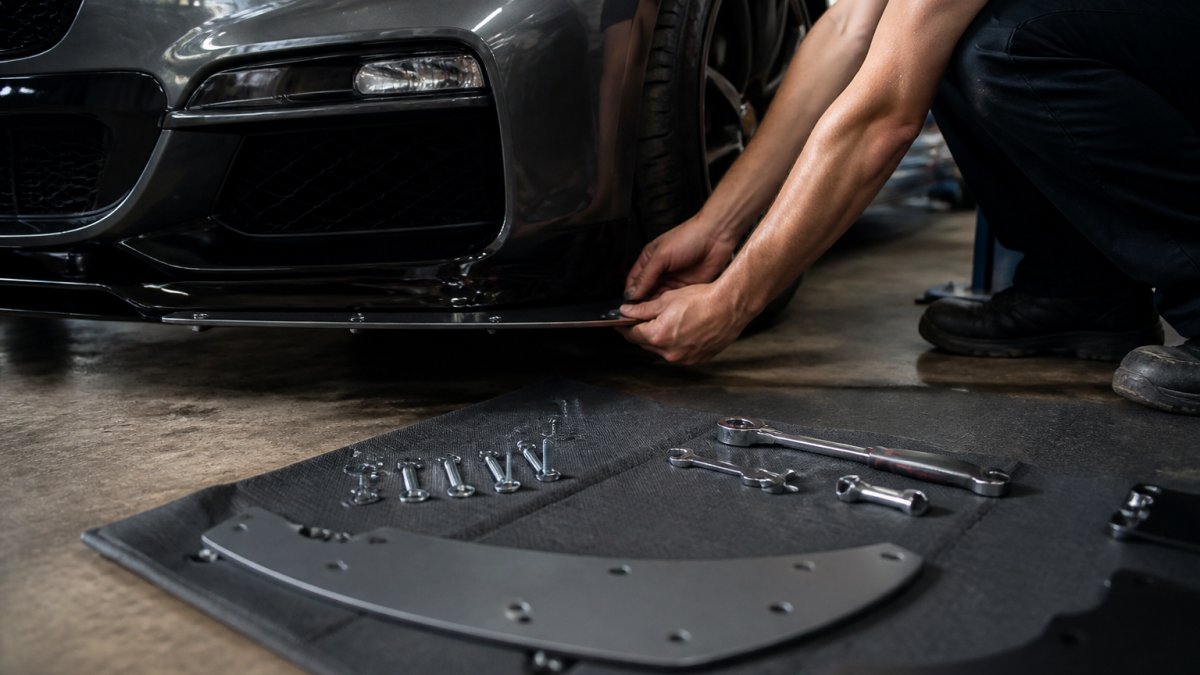
Professional installation gives you a paper trail. A shop invoice shows who did the work and when. If a mounting point cracks later, that record matters.
DIY installation saves money but shifts the risk to you. Over-torquing fasteners or drilling unsealed holes can cause rust or stress cracks, and a dealer can point to that damage to deny a related claim.
- Keep every receipt and torque spec.
- Photograph each step of the install.
- Use the hardware the kit maker supplies.
Performance Parts Warranty Coverage: Part Warranty vs. Vehicle Warranty
Two warranties are in play. Performance parts warranty coverage protects the aftermarket part; the vehicle warranty protects the car. Confusing them is where owners lose money.
The part warranty is a limited warranty from the maker or seller covering defects in the part itself, not damage it causes to your car.
| Warranty Type | What It Covers | Who Honors It | Typical Trigger |
|---|---|---|---|
| Vehicle warranty | Car components and systems | Manufacturer or dealer | Manufacturer defect |
| Part warranty | The aftermarket part itself | Part maker or seller | Defect in the part |
| Installation coverage | Workmanship of the install | Installing shop | Install-related failure |
Check the warranty period and any mileage limit on the part. Most run from the in-service date of the part, not the car.
Aero-Kit-Specific Failure Scenarios Manufacturers Watch For
Aero parts fail in predictable patterns that claim assessors look for. The useful question is not "will a kit void my warranty" but "which factory systems can this part plausibly affect, and how would a dealer prove the link?" Here are the most common scenarios.
Mounting and fastener failures
A splitter or side skirt screwed into a plastic bumper cover rather than a structural member concentrates load at a few small holes. At highway speed, vibration and air pressure work fasteners loose, causing pull-through, stress cracks, and, worst case, panel separation. An assessor can point to the non-factory holes as evidence the part caused the damage, making a denial genuinely defensible.
Downforce and mounting-point stress
A functional wing or large splitter changes aerodynamic load on factory mounting points never designed for it. Hairline cracks around the mounting area grow into panel or trunk-lid fatigue, plausible on track cars, rare on street cars at legal speeds. If you run a functional wing, inspect and photograph the mounting area every few thousand miles.
Water intrusion and corrosion
Every hole drilled through a panel is a path for water. Unsealed holes in a trunk lid, hatch, or rocker panel let water into cavities that drain poorly, and corrosion follows, and rust coverage is one of the first things a manufacturer scrutinizes. Seal every hole with a grommet or seam sealer and re-check after the first rainy season.
Clearance, scraping, and impact damage
Lowered splitters and diffusers scrape on driveways, speed bumps, and parking blocks, cracking the part and transferring impact into the bumper cover or undertray. A cracked undertray that tears loose at speed is a safety issue. If your kit sits lower than the factory lip, measure your regular driveways before install.
Sensor, camera, and radar interference
Front splitters, bumper extensions, and grille surrounds can block or reflect the radar, cameras, and ultrasonic sensors used by adaptive cruise, automatic emergency braking, and parking assist, causing false alerts or degraded function. Before install, confirm the kit covers no sensor aperture, and have camera or radar calibration redone by a qualified shop if the bumper cover is removed.
Cooling airflow and underbody changes
A front splitter or underbody panel changes how air reaches the radiator, intercooler, and brakes. The street effect is usually small, but a poorly designed panel that traps air or blocks a duct can contribute to overheating. Verify factory cooling ducts and brake cooling paths remain open.
Adhesive and trim failure
Taped-on trim, lip spoilers, roof extensions, fender flares, can lift in heat, car washes, or at speed, taking paint with it or striking the body. Adhesive failure is rarely a car-warranty matter but is a common part-warranty claim, so keep the install date and surface-prep record.
Once your kit is on, upkeep matters as much as the install. Our guide on how to maintain performance aero parts walks through the checks that keep hardware tight and panels sealed.
Your Legal Protections and the Burden of Proof
The burden of proof generally sits with the manufacturer.
In practice, a dealer may deny first and explain later. Your job is to make the causation argument hard for them to win.
- Keep records that show the part was installed correctly.
- Show maintenance was done on schedule.
- Document that the failure is unrelated to the modification.
Many owners win appeals simply by presenting a clean paper trail. The law is on your side when you can prove the part didn't cause the failure.
The Pre-Installation Checklist and Claim Documentation Process
Prep before you turn a wrench saves arguments later, and a clear process after a denial is what gets claims paid. Here is the checklist we would run on our own cars, plus the appeal path most owners never use.
Pre-installation checklist
- Photograph the car from every angle before install, including close-ups of the mounting areas
- Save the part's warranty terms and conditions in a dedicated folder
- Confirm the kit fits your exact make, model, trim, and model year, not just the generation
What to photograph and save before you install
Shoot the factory panels, mounting areas, and odometer. Save the part's terms, receipt, and install instructions in one folder, physical and digital. Owners win appeals not because the law is unclear but because they can show a clean, dated record the dealer cannot rebut.
Which warranty are you actually claiming against?
Before you file anything, identify the right party. There are three separate warranties in play, and filing against the wrong one wastes weeks.
| If the problem is... | Claim against... | What you need |
|---|---|---|
| A defect in the aero part itself | The part maker's limited warranty | Receipt, in-service date, photos of the defect |
| Poor workmanship from the install | The installing shop's workmanship coverage | Invoice, install date, photos of the failed joint |
| A factory component the kit may have affected | The vehicle manufacturer's warranty | Service records, install records, causation argument |
How to file a vehicle warranty claim
File the claim in writing, not by phone, and describe the symptom rather than volunteering the modification. Under the Magnuson-Moss Warranty Act, a manufacturer that conditions coverage on the use of specified parts must show the aftermarket part caused the failure, so a written denial that cites only "modified vehicle" is weak and worth challenging.
How to appeal a denied claim
- Get the denial in writing. Ask the service manager to state the failed component, the modification allegedly responsible, and the exclusion cited.
- Assemble your file. Install invoice, photos before and after, maintenance records showing scheduled service was done, and the part's warranty terms.
- Respond in writing to the dealer with the causation argument: the part was installed correctly, maintenance was current, and the failed component is not one the part plausibly affects.
- Escalate to the manufacturer's customer service or regional warranty representative if the dealer will not reconsider. Keep every email and note every call with date and name.
- If the manufacturer still refuses, ask whether the denial can be reviewed under the manufacturer's dispute process, and consider a consumer-protection complaint through your state attorney general's office or the FTC complaint portal.
- For a part-warranty dispute, go back to the part maker or seller with the same file, the part warranty is a separate contract and is not affected by the vehicle manufacturer's decision.
Documenting maintenance between install and claim
A denial is much harder to defend when the owner can show scheduled maintenance was done on time. Keep oil change, tire rotation, and inspection records, and note any dealer visit where the modification was visible and not flagged, that silence is useful evidence.
Choosing a Warranty-Safe Aero Kit for Your Build
The safest kit fits correctly and doesn't stress factory mounting points.
We stock kits built for specific vehicles, so you are not guessing. BMW owners can shop our BMW M Style Body Kits Performance Parts collection. Browse our Tesla Carbon Fiber Parts Body Upgrades collection to explore options.
Best for: owners who want a clean fit and a paper trail. Skip if: you need custom fabrication for a one-off build.
Every kit we sell ships with the hardware and instructions you need to install it right.
Frequently Asked Questions
Will an aero kit void my car warranty?
Not automatically. Under the Magnuson-Moss Warranty Act, a manufacturer cannot void your entire vehicle warranty simply because you installed an aero kit. What it can do is deny a specific warranty claim if it can show the modification caused the failure. A cosmetic splitter rarely affects a powertrain claim, but an aero part that blocks airflow to a cooling component could be linked to an overheating repair. The aero kit warranty question is really about causation on a specific claim, not blanket voiding.
Can a manufacturer deny a warranty claim after I install a body kit?
Yes, but only with evidence. The manufacturer or dealer must demonstrate a causal connection between your body kit and the failed part. If your transmission fails and your only modification is a rear diffuser, a denial is hard to justify. Ask for the denial in writing with the specific exclusion cited. Keep your installation receipts, photos, and the part's own product warranty. If the denial looks unsupported, you can escalate to the manufacturer's regional office or reference your rights under the Magnuson-Moss Warranty Act.
What should I document when installing an aftermarket aero kit?
Photograph the vehicle before installation, including the stock bumper and mounting points. Save the purchase receipt, the part's limited warranty terms, and any professional installation invoice. Record mileage and the in-service date at the time of install. After installation, take photos of the finished fitment and keep a log of any maintenance. If a warranty claim arises later, this documentation helps show the modification was installed correctly and lets you argue against an unsupported denial.
Does an aero kit affect coverage for unrelated repairs?
It should not. Warranty coverage is claim-specific, so an aero kit on your exterior should not affect a covered repair for, say, a failed alternator or infotainment unit. Problems arise when a dealer tries to apply a blanket modification exclusion. If that happens, request the denial in writing and point to the lack of causal connection. Keep your maintenance records current, since wear and tear and missed service are separate grounds a manufacturer can legitimately cite.
A denied claim is stressful, but it is rarely the end of the story. The owners who win are the ones with photos, receipts, and a clear argument that the part didn't cause the failure. Prop & Piston helps you start on the right foot with vehicle-specific aero kits, in-stock items shipping in 1-2 business days, and a 30-day return window if the fit isn't right. Get started with Prop & Piston and build a setup you can defend.
