
How to Verify Car Part Fitment Before You Buy
Editorial Team · November 01, 2026
Last Updated: November 2, 2026
Quick Summary
To verify part fitment, start with your vehicle's year, make, model, and trim, then confirm engine size, engine type, and drivetrain before opening any product page. Cross-check the listing's fitment chart notes and part number against a second source, since a VIN narrows fitment but does not guarantee it.
- A VIN is a 17-character code that describes your vehicle as built, not later changes.
- If a license plate lookup and VIN lookup disagree, the VIN wins.
- Read fitment chart footnotes about body styles and option packages, not just the green check.
- A superseded part number means the maker updated or replaced a part that should still fit.
- Confirm the production date from the door jamb, not just the model year, before ordering.
Table of Contents
- Start With Your Vehicle Details, Not the Part
- How to Check Part Fitment by VIN and License Plate
- Year Make Model Part Fitment: Using Vehicle Selectors and Fitment Charts
- Automotive Part Number Lookup: OEM, Aftermarket, and Superseded Numbers
- Interchangeable Car Parts Lookup: Cross-References and What They Really Mean
- When the Data Conflicts: Production Dates, Option Packages, and Regional Variations
- Verify Used, Salvaged, and Remanufactured Parts Before You Pay
- Confirm Fitment on a Prop & Piston Aero Kit Before You Order
- Frequently Asked Questions
Start With Your Vehicle Details, Not the Part
Most buyers start with the part. That is the mistake. To learn how to verify car part fitment, you have to start with the car, because part fitment is decided by the vehicle long before you ever open a product page.
The fix is a fixed order of checks. Get the vehicle details right first, and every later step gets easier.
Year, Make, Model, and Trim: The Four Fields That Decide Fitment
These four fields are the backbone of vehicle compatibility. Year, make, model, and trim narrow millions of parts down to a short list. Skip trim and you risk buying a part built for a different submodel.
A product listing should spell out those fields clearly. Our BMW 4 Series M4 Style front bumper conversion kit lists its years, body styles, and trim coverage up front, so you can match your car before you order.

- Year: use the production year, not the model year on the title alone
- Make: the manufacturer, spelled as the catalog spells it
- Model: the chassis code helps, such as F32 or G30
Engine Size, Engine Type, and Drivetrain
Engine and drivetrain details matter more than most people expect. Engine size, engine configuration, and drivetrain can change clearance, cooling, and mounting on many parts. A part that fits one engine bay may not fit another in the same model year.
Check these three fields on your vehicle:
- Engine size and engine type
- Drivetrain, such as rear-wheel or all-wheel drive
- Transmission, when the listing calls it out
How to Check Part Fitment by VIN and License Plate
A VIN can help narrow part fitment, but it is not a guarantee. The vehicle identification number is a 17-character code that identifies your vehicle as built.
What Each VIN Position Tells You
You do not need to memorize the whole code, but knowing the structure helps you spot bad data:
- Positions 1-3 (WMI): the world manufacturer identifier, who built the vehicle and where
- Positions 4-8 (VDS): the vehicle descriptor, model, body style, engine, and restraint system
- Position 9: a check digit used to validate the VIN
If a decoder returns a model year or engine that contradicts your registration or door-jamb sticker, stop and reconcile before you trust any part number it suggests.
A VIN Lookup Workflow That Survives Conflicting Results
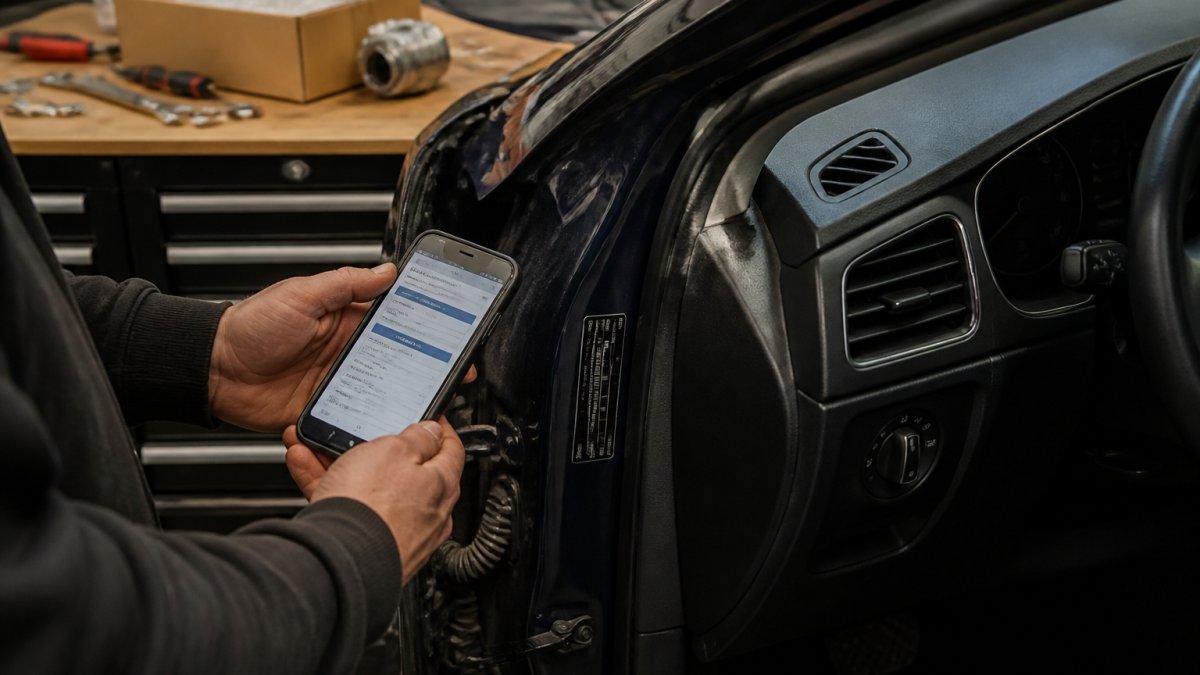
- Find the VIN on the dashboard plate or driver's door jamb, and confirm the two match
- Enter it in a parts catalog or vehicle selector
- Note every part number the tool returns, plus the build details it reports (engine, drivetrain, production date)
- Cross-check those numbers against a second source, a dealer parts counter, a manufacturer catalog, or a different lookup tool
- If two sources disagree, trust the one that shows the most specific build data (production date, option codes, engine code) over the one that only shows year/make/model
Why VIN Decoders Disagree
A VIN decoder can miss fitment in several common ways:
- Mid-year changes: manufacturers sometimes switch a part during a production run without changing the model year. A VIN alone may not flag the split.
- Option packages: a factory package (sport suspension, tow package, cold-weather group) can change mounting points or connectors, and not every decoder reports option codes.
- Aftermarket modifications: a swapped engine, transmission, or body panel is invisible to a VIN lookup.
When a decoder result conflicts with the listing, ask the seller to confirm your full VIN against the part, not just the year and model.
License Plate Lookup: Convenient but Dependent on Registration Data
License plate lookup works the same way, but it depends on accurate registration data. A plate can be transferred, a registration can lag a title change, and some states do not expose full build details through plate tools. Treat plate lookup as a convenience layer on top of the VIN, not a replacement for it.
Treat both tools as a starting point, not the final word. A VIN cannot tell you about every factory option or every post-sale change, so confirm the result against the listing and, when in doubt, against the manufacturer's own catalog.
Here is what each VIN position tells you, so you can spot bad data before trusting a part number.
| VIN position | What it identifies |
|---|---|
| Positions 1-3 (WMI) | World manufacturer identifier: who built the vehicle and where |
| Positions 4-8 (VDS) | Vehicle descriptor: model, body style, engine, restraint system |
| Position 9 | Check digit used to validate the VIN |
| Position 10 | Model year code |
| Position 11 | Assembly plant code |
| Positions 12-17 | Sequential production number |
Year Make Model Part Fitment: Using Vehicle Selectors and Fitment Charts
Year make model part fitment tools are the workhorse of any parts search. A vehicle selector filters a catalog down to parts built for your exact car. A fitment chart does the same job in table form.
Use both, and read them closely:
- Enter year, make, model, and trim in the selector
- Confirm the result matches your engine and drivetrain
- Open the fitment chart and read the notes, not just the green check
The notes are where the real answers live. A chart may say "fits" and still carry a caveat about a specific submodel.
Automotive Part Number Lookup: OEM, Aftermarket, and Superseded Numbers
An automotive part number lookup turns a vague search into an exact match. The OEM part number is the factory's own identifier for a part. The aftermarket part number is the replacement maker's identifier.
Search by part number when you can. Then compare:
- OEM number against the aftermarket number
- The listing's number against your vehicle's catalog result
- Old numbers against newer ones, since a superseded part number replaces an older one
A superseded part number means the maker updated or replaced a part. The new number should still fit the same vehicles. If a seller lists only an old number with no cross-reference, ask before you buy.
2025 Matrix-Style Dual-Color LED Headlights for Porsche 911 (991) 2013–2018 →
Interchangeable Car Parts Lookup: Cross-References and What They Really Mean
Interchangeable car parts lookup is where buyers get burned. An interchange number tells you a part can stand in for another, but "interchangeable" has limits. Two parts may swap across models and still differ in connectors, mounting tabs, or finish.
Cross-reference the number, then check the details:
- Confirm the same connectors and mounting points
- Check the finish and material match
- Verify the years and models the interchange covers
Compatible parts are not always identical parts. Read the cross-reference as a lead, then confirm it against the product listing.
When the Data Conflicts: Production Dates, Option Packages, and Regional Variations
Conflicting fitment data is normal, and it usually has a cause. Production dates, factory options, and regional variations create splits that a simple year range hides. The fix is to treat every conflict as a question with a specific answer, not as noise to ignore.
Production Dates: The Split a Year Range Cannot Show
A model year is not a production date. Manufacturers run a model year across many months and sometimes change a part mid-run.
Our pre-LCI G30 5 Series M5 Style bumper kit fits only the pre-refresh cars, and the listing says so plainly. Our E46 M3 Style bumper kit covers sedans, coupes, and convertibles across several years, which is exactly why body style matters so much.


To read a production date correctly:
- Find the build date on the driver's door jamb sticker or the manufacturer's build sheet
- Compare it to the split date in the listing or catalog notes, not just the year
- If the listing gives only a year range, ask the seller whether the part covers both sides of the split
Option Packages and Factory Codes
Two cars with the same year, make, model, and trim can still differ because of factory options. Sport packages, tow packages, cold-weather groups, and lighting packages can change brackets, connectors, and clearance. Many manufacturers encode these as option codes on the build sheet or door jamb; a VIN decoder may or may not surface them.
When a listing says "fits" but carries a footnote about an option package, treat the footnote as the real answer. Confirm your option codes against the listing before you order.
Regional and Emissions Variations
Vehicles built for different markets can carry different emissions hardware, lighting, and bumper structures under the same year/make/model. If you are buying a part sourced from another region, confirm the part number against your vehicle's catalog rather than assuming the nameplate match is enough.
A Resolution Workflow for Conflicting Sources
When sources disagree, do this in order:
- Trust the more specific listing over the broader one
- Check the production date, not just the year
- Confirm factory option packages that change mounting
- Compare the part number against the manufacturer's catalog, not just the seller's listing
- Ask the seller to confirm your VIN and build date against the part
If the seller cannot confirm your build details against the part, that is your answer: do not order until they can.
Verify Used, Salvaged, and Remanufactured Parts Before You Pay
Used and salvaged parts need extra checks. A used part may come from a car with different options, and a remanufactured part may have changed connectors during the rebuild. Verify the part number, the donor vehicle, and the condition before money changes hands.
Before you pay, confirm:
- The part number matches your catalog result
- The donor vehicle's year, model, and trim
- Photos of connectors and mounting points
Warranty terms matter here too, so check them before you commit.
Confirm Fitment on a Prop & Piston Aero Kit Before You Order
Every step above comes together on a real order. Before you buy an aero kit from us, run the same checks: year, make, model, trim, engine, and drivetrain.
A common mistake is ordering by looks alone. For a deeper walkthrough, see How to Verify Car Aero Kit Fitment. Kit listings state their fitment, and confirming before you order helps avoid returns.
Frequently Asked Questions
Can I use my VIN to verify car part fitment?
Yes, and it is the most reliable single check you can make. A vehicle identification number encodes the model year, plant, engine, and trim level as built, so a VIN-based lookup narrows the parts catalog to your exact configuration. The catch is that a VIN does not record modifications made after delivery, and it will not flag mid-year production changes unless the lookup tool is current. Use the VIN result as your starting point, then confirm against the part number and a physical measurement before ordering.
Why might a part listed for my year, make, and model still not fit?
Year, make, and model describe a family of vehicles, not one build. Trim level, engine configuration, drivetrain, option packages, and production date all change which part was installed at the factory. A bumper listed for a 2017-2020 model range can still be wrong if your car is the facelifted version, and a headlight listed for the right generation can differ by connector or DRL version. Always drop down to trim and production date, and check the seller's fitment notes for exclusions.
What is an interchange number and how do I use it?
An interchange number is a cross-reference code that groups parts considered equivalent across models or brands. During an interchangeable car parts lookup, you match your original part number to the interchange number, then search that number to see which other vehicles and part numbers share it. It is useful for finding used or salvaged replacements. Treat it as a lead, not a guarantee: interchange listings often group parts that differ in connector type, finish, or sensor provision, so compare the physical details before buying.
How do I confirm an aero kit or bumper will fit before ordering?
Match the listing's stated year range and body style to your car first, then check the specific notes. For example, the 2014-2020 BMW 4 Series M4 Style Front Bumper Conversion Kit lists F32 coupe, F33 convertible, and F36 gran coupe fitment and states that trim, drivetrain, and transmission do not affect fit within that production range. Confirm whether you need PDC holes pre-drilled, decide between fog light and fog-delete configurations, and expect a professional paint job since body kits ship unfinished.
Fitment mistakes cost time, money, and a weekend in the garage. Prop & Piston builds performance aero kits for enthusiasts who care about exact fit, with a performance parts finder built around your specific make and model. In-stock items ship in 1-2 business days, and every order comes with 30-day returns and secure checkout through Shop Pay, cards, or PayPal. Get started with Prop & Piston and order the part that fits your car the first time.
